
The Zero-Footprint SEMICONDUCTOR FAB™ — Article 2
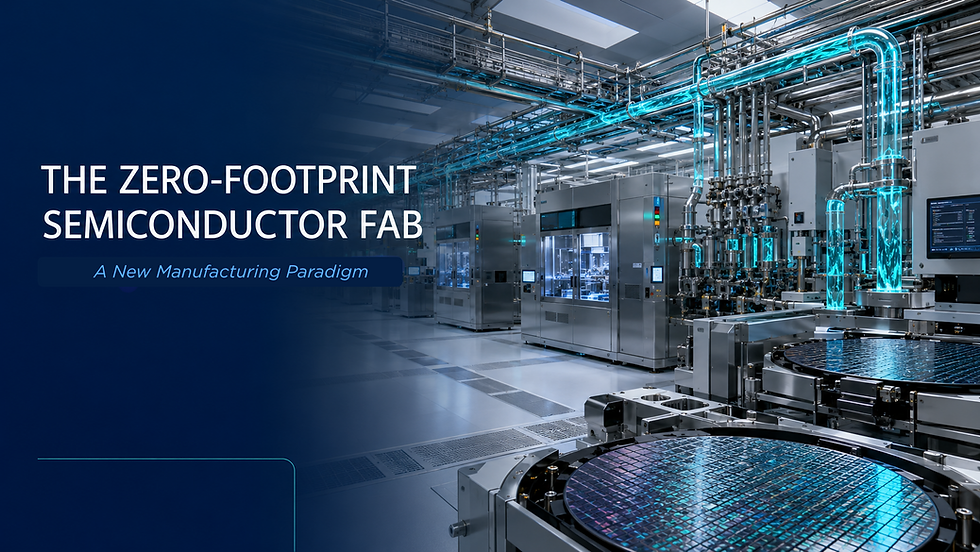
Article 2 | New Manufacturing Paradigm
Semiconductor manufacturing has achieved extraordinary gains in precision, performance, and productivity. However, the infrastructure that manages water, chemicals, energy, and process waste has not evolved at the same pace. In many fabs, resources still move through a largely linear system: purchase, purify, use, combine, treat, and discharge.
That model supported decades of growth, but it becomes increasingly difficult to sustain as process complexity rises, water supplies tighten, environmental requirements increase, and critical materials become more strategically important. Building larger centralized treatment systems may add capacity, but it does not correct the basic loss of value that occurs when recoverable streams are mixed and managed as waste.
The Zero-Footprint Semiconductor Fab proposes a different manufacturing architecture. Its objective is not literal zero impact. It is the progressive reduction of freshwater use, chemical consumption, material loss, energy demand, and wastewater discharge by preserving resources at their highest practical value throughout the fab.
The current model loses value by design
A fab may produce ultrapure water at considerable cost, use it for a brief rinse, and then combine it with streams containing concentrated chemicals, metals, fluoride, solvents, or particles. Once combined, the relatively clean water becomes more difficult to reuse, concentrated materials become diluted, and the treatment system must work harder to separate what the facility has mixed together.
The same problem applies beyond water. Process chemicals may leave the tool before their value is exhausted. Metals and other materials may remain technically recoverable but become uneconomic after dilution. Heat and pressure may dissipate without consideration of where they could reduce demand elsewhere in the facility.
The result is an end-of-pipe system designed primarily to achieve discharge compliance. Compliance remains essential, but it should represent the minimum requirement rather than the organizing principle for future fab infrastructure.
A new architecture for fab resources
The zero-footprint approach begins inside the manufacturing process. It treats each process stream as a potential resource with a specific composition, flow pattern, location, and reuse or recovery pathway. Decisions depend on what the stream contains, how it changes, and what quality the next use requires.
Design principle | Change in the fab | Value created |
Measure | Characterize composition, flow, timing, and variability at the process-stream level | Reliable mass balances and recovery decisions |
Segregate | Keep clean, concentrated, and incompatible streams separate | Lower treatment burden and higher recovery potential |
Recover close to source | Use selective and distributed treatment before dilution or mixing | Smaller systems and more valuable recovered outputs |
Reuse by quality | Match recovered water and chemicals to the actual requirement of the next use | Less over-treatment and lower demand for new inputs |
Integrate and optimize | Connect distributed systems with central utilities, controls, and verified data | Stable operation, resilience, and continuous improvement |
Table 1. The zero-footprint model manages resources according to their quality, location, and recovery potential.
The transformation is architectural, not a single technology
No single separation technology can create a zero-footprint fab. The architecture combines process knowledge, real-time monitoring, selective separation, advanced membranes, electro-separation, point-of-use systems, centralized utilities, and intelligent controls. Each technology has a defined role based on stream chemistry and the quality required for reuse.
Central systems will remain important. They provide essential capacity, redundancy, and final treatment. The change is that they no longer carry the full burden of recovering value from mixed streams. Distributed systems address selected streams near the source, while the central plant manages the remaining load and protects the overall facility.

Figure 1. The manufacturing paradigm shifts from linear resource consumption to a connected system that measures, separates, recovers, and reuses resources.
The business case extends beyond sustainability
Water availability, wastewater capacity, chemical supply, and permitting can constrain production. A fab that recovers and reuses resources can reduce its exposure to these constraints and create more flexibility for expansion. It may also reduce the size of future utility additions and avoid using high-value plant space for ever-larger end-of-pipe systems.
Resource recovery can also improve operating visibility. Process-level data helps teams identify abnormal losses, changing chemistry, and treatment inefficiencies earlier. The same information that enables recovery can support yield protection, maintenance planning, and more reliable utility operation.
The strongest projects will therefore be evaluated as manufacturing-infrastructure investments. Their value can include avoided water purchases, lower waste-management cost, recovered chemicals or materials, deferred capital, regulatory resilience, and reduced production risk.
A practical transition for existing and new fabs
New fabs can incorporate segregation, monitoring, and recovery pathways during design. Existing fabs can move toward the same objective incrementally. The starting point is not a facility-wide rebuild. It is the identification of streams with high flow, high disposal cost, limited treatment capacity, recoverable value, or a clear reuse destination.
Each opportunity can then move through a disciplined sequence: establish the mass balance, characterize variability, define the recovery target, pilot the selected separation approach, integrate controls, and verify long-term performance. Successful projects become repeatable building blocks for the broader fab architecture.
The fab of the future preserves value
The semiconductor industry has transformed manufacturing through precise control of materials and processes. The next opportunity is to apply that same discipline to the resources surrounding production.
The Zero-Footprint Semiconductor Fab does more than treat waste more efficiently. It prevents valuable water, chemicals, energy, and materials from becoming waste prematurely. It connects process data with physical separation and creates recovery pathways that support both sustainability and manufacturing resilience.
That is the new manufacturing paradigm this series will explore.
Exergy Systems, Inc.
Engineering a Sustainable Future
Comments