
The Zero-Footprint Factory™ Series — Introduction

The Factory of the Future Begins by Rethinking Waste
For more than a century, manufacturing plants have been designed around a simple assumption: use resources once, treat the waste, and buy more tomorrow.
Water enters the plant, is used, and becomes wastewater. Chemicals degrade and are replaced. Valuable metals are lost in rinse waters, sludges, and spent solutions. Energy is consumed to move, treat, and dispose of materials that still have value.
This linear approach has served industry well, but it is no longer sustainable.
Growing water shortages, rising disposal costs, tighter environmental regulations, and increasing pressure to improve operational efficiency are exposing the limitations of yesterday's factory designs.
The question is no longer "How do we treat more waste?"
The question is: "Why are we creating so much waste in the first place?"
Rethinking the Industrial Paradigm
As we work with manufacturers across multiple industries, one thing becomes increasingly clear:
The deeper we examine industrial processes, the more opportunities we find to eliminate waste before it is ever created.
Much of what leaves a plant as "waste" is not waste at all. It is simply a valuable resource that has become mixed with contaminants.
Water still has value.
Metals still have value.
Chemicals still have value.
Many process chemicals retain significant value long before they are discarded.
The challenge is that most factories were never designed to recover them.
Building the Zero-Footprint Factory
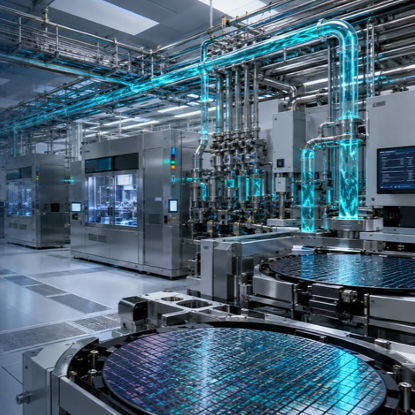
The Factory of the Future is not simply today's plant with a larger wastewater treatment system.
The Factory of the Future is not simply today's plant with a larger wastewater treatment system.
The Factory of the Future is not simply today's plant with a larger wastewater treatment system.
This requires a new way of thinking about manufacturing:
Design process lines for resource recovery instead of disposal.
Integrate water, chemical, and material recycling into production.
Use AI and advanced process monitoring to match resource quality with process requirements.
Recover valuable materials before they become waste streams.
View wastewater treatment as the last option—not the primary strategy.

Retrofitting Existing Facilities
Fortunately, manufacturers do not have to build entirely new plants to realize these benefits.
Many existing facilities can be transformed through strategic retrofits.
By identifying high-value recovery opportunities and integrating advanced separation technologies, manufacturers can significantly reduce fresh water consumption, recover valuable chemicals and metals, lower operating costs, and extend the life of critical resources.
Small changes at key process points often deliver disproportionately large improvements in efficiency.
The Future Is Circular
The future of manufacturing is not simply cleaner.
It is smarter.
It is data-driven.
It is circular.
Factories of the future will measure success not only by production output, but by how efficiently they use every gallon of water, every kilogram of raw material, and every unit of energy.
Waste should become the exception—not the rule.
At Exergy Systems, we believe the Zero-Footprint Factory is not a distant vision. It is an achievable engineering objective that begins by asking a simple question:
What if waste wasn't inevitable?
Contact us to help you build a waste and pollution free factory…


Comments